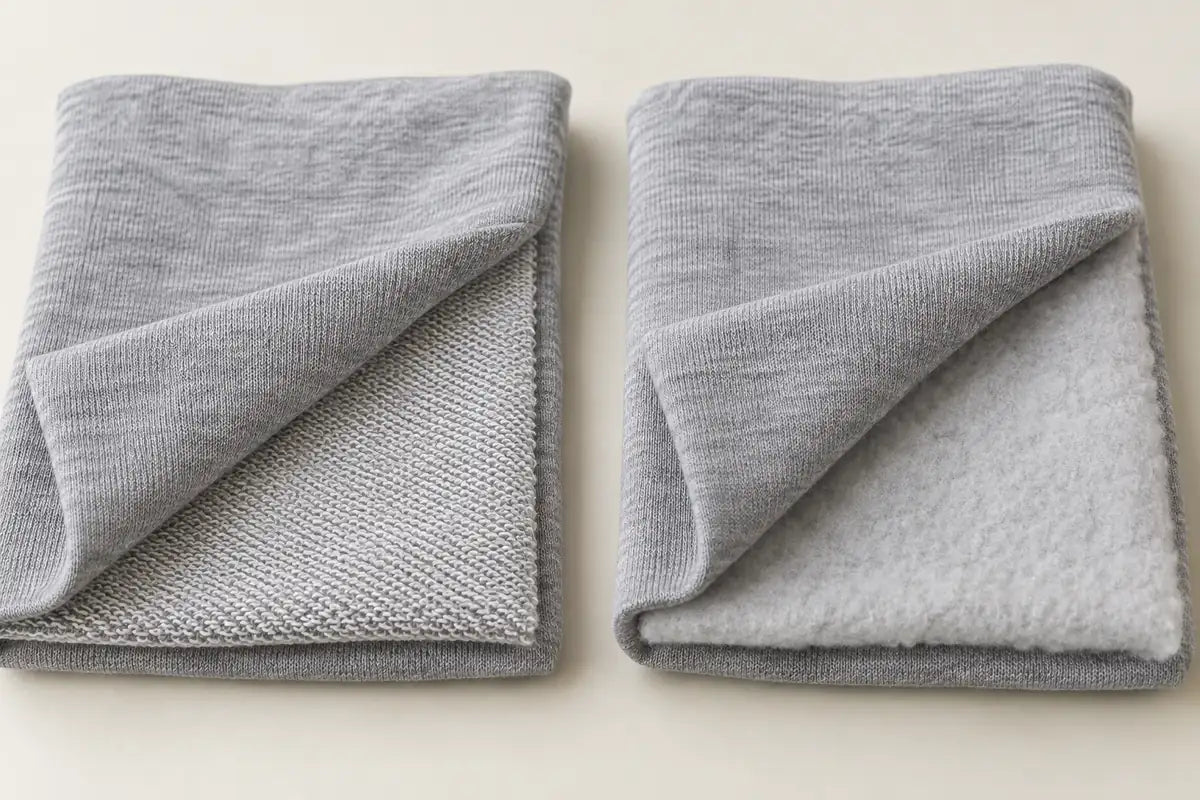
AI-generated illustration for comparison only. Not a photograph of actual fabric samples, YJ stock or test results; do not use the depicted texture to identify or approve a fabric.
The main difference in French terry vs fleece for hoodies is the inside surface. French terry keeps its unbrushed loops, while brushed sweatshirt fleece has a raised, fuzzy back. Start with French terry if you want a loopback feel. A cold-weather brief calling for a plush interior is a reason to sample brushed fleece.
This guide compares French terry fabric with brushed sweatshirt fleece, not every fabric sold as fleece. Polar fleece is a different sourcing category, as shown by Polartec’s synthetic fleece range. Send a reference swatch or inside photograph when asking a supplier for “fleece.” Otherwise, you and the supplier may be picturing different materials.
French terry and brushed fleece at a glance
CottonWorks explains the loopback and napped-back distinction in its guide to knit constructions. Neither name specifies fiber content. Ask for the composition: French terry does not mean cotton, and fleece does not mean polyester.
| Comparison | French terry | Brushed sweatshirt fleece |
|---|---|---|
| Inside surface | Visible, unbrushed backing loops | Raised fibers forming a fuzzy back |
| Sampling direction | Try it when a looped interior is part of the brief | Try it when a plush interior is part of the brief |
| Fabric specification | Confirm composition, finished weight and finish | Confirm the same details, including the brushing reference |
| Before approval | Review the sewn and washed sample | Review the sewn and washed sample, including the nap |
Warmth and softness are different questions
Brushing, also called napping, raises fibers from the fabric surface to create that plush feel. It is a finishing process, not a fiber composition. CottonWorks describes the process in its mechanical finishing guide. Ask to feel the intended finish rather than choosing from a photograph of the outside face.
A hoodie can feel soft on the sample table and still miss your customer's warmth requirements. Compare samples for the actual use: worn indoors, layered under a jacket or worn alone outside. A dense French terry hoodie should not automatically be described as cool or breathable. Equally, a fleece label is not a temperature rating.
If warmth or moisture-vapour performance is a selling claim, agree appropriate testing with the supplier and laboratory. For example, ISO 11092 measures thermal and water-vapour resistance under steady-state conditions. Its scope does not provide a universal comfort pass mark or represent a specific wearing situation.
Use fabric GSM to compare weight, not to rank quality
GSM means grams per square metre: the mass of a given area of fabric. It is not the weight of the whole hoodie. ASTM D3776/D3776M covers fabric mass-per-area measurement; that measurement does not tell you how a finished hoodie will fit or feel.
Consider a hypothetical comparison between two fabrics both specified at 320 GSM. The number alone cannot tell you which is warmer, which hangs more cleanly or which keeps its appearance after washing. Keep GSM in the specification, but put composition, construction and finish beside it. The example is not a recommended weight for every hoodie.
The quote should identify whether GSM refers to the finished fabric you will approve. Agree its tolerance and measurement basis. Record usable width too. A price per metre cannot be compared fairly without knowing how much usable fabric that metre provides.
Check the fabric in the hoodie you intend to sell
You cannot judge an oversized pullover or a fitted zip hoodie from a swatch alone. Ask for a sample in the intended material and review it against the size chart and reference silhouette.
- Check how the hood sits both up and down, with the intended single or double layer.
- Look at the shoulder line, sleeve volume and body drape while the garment is worn.
- Inspect the pocket opening and seam bulk rather than judging only the flat front.
- Check cuff and hem rib recovery and their appearance beside the body fabric.
A switch from French terry to brushed fleece, or the reverse, calls for another garment review before bulk approval. Do not assume the same pattern and rib combination will give an identical result. Use our garment fit comments template to separate a fabric concern from a measurement or construction change.
Compare washed samples before choosing a winner
Neither fabric name guarantees low shrinkage or a pill-free surface. CottonWorks recommends evaluating finished knit fabric and checking its performance again in garment form in Designing Knit Textiles. Agree the wash and drying procedure, number of cycles and acceptance criteria before comparing results.
Keep an unwashed reference and record the sample measurements. After the agreed wash procedure, compare body length, chest width, sleeves and overall shape. Look for seam movement, changes around the hem and pocket, and differences between the body and rib. Our fabric shrinkage guide for pants explains the measurement approach; a hoodie still needs its own agreed checks.
Surface appearance needs a separate check. Photograph both sides in comparable lighting and note pilling, loose lint or a change in the brushed texture as distinct observations. “Still feels soft” is not a complete wash report. Where a formal pilling result is needed, agree a suitable test method and assessment criteria instead of inventing a pass grade from a photograph.
Approve printing or embroidery on the selected fabric
The inside finish does not, by itself, decide whether the outside is suitable for your logo. Send the decorator the actual fabric composition, color and finish, together with artwork size and placement. Ask what the decoration process needs from that fabric.
Review the decoration sample on the approved material, then include it in the agreed wash review. Inspect the graphic or stitching and the surrounding fabric, not just the logo in isolation. Our logo artwork checklist covers the information to prepare. Changing the fabric after artwork approval should trigger another compatibility check.
Compare complete quotes, then confirm your fabric choice
Neither the cheaper quote nor the better fabric can be identified from the inside finish alone. Request quotes against the same garment brief and record the proposed fabric specifications. If a lower quote uses a different blend, weight, finish or usable width, it is not the same offer.
Before asking for a hoodie quote, prepare:
- A reference garment or photos of both fabric surfaces, plus the intended season and use.
- The target composition, finished GSM and approved hand-feel reference.
- The hoodie silhouette, size chart, hood construction and rib requirements.
- Colors, quantity per color and size breakdown.
- Logo artwork, decoration placement, trims and packaging requirements.
- The sample and wash checks that must be agreed before bulk approval.
You can send YJ your hoodie brief with these details. Fabric options, MOQ, sampling terms, price and lead time need confirmation for the specific style. Choose the option that meets the brief in the sewn and washed sample, and keep that approved reference tied to the bulk order.
Frequently asked questions
Is French terry or fleece warmer for a hoodie?
Start by sampling brushed sweatshirt fleece if you want a plush cold-weather hoodie. That does not mean it beats every French terry fabric for warmth. Compare the actual materials and garment construction, with agreed performance testing if warmth is a product claim.
Is French terry always 100% cotton?
No. French terry describes a fabric construction and unbrushed back, not a guaranteed fiber composition. Request the supplier’s composition specification. Do the same for brushed sweatshirt fleece rather than assuming it is all polyester.
What GSM should I choose for custom hoodies?
Start with a reference garment, the intended use and the silhouette you want. Then compare finished fabrics and sewn samples. There is no single GSM for every hoodie, and a higher number alone does not prove better quality. Record the chosen weight and tolerance.
Which fabric shrinks or pills less?
The names alone cannot answer that. Compare the chosen fabrics using agreed care conditions and acceptance criteria. Check garment measurements and surface appearance separately, and specify a suitable pilling test if you need a formal result.
Can both French terry and brushed fleece carry a printed logo?
Both can be considered, but approve the print on the exact selected fabric. The face, composition, finish and color matter to the decoration process. Confirm suitability with the decorator and assess the decorated sample after the agreed washing procedure.