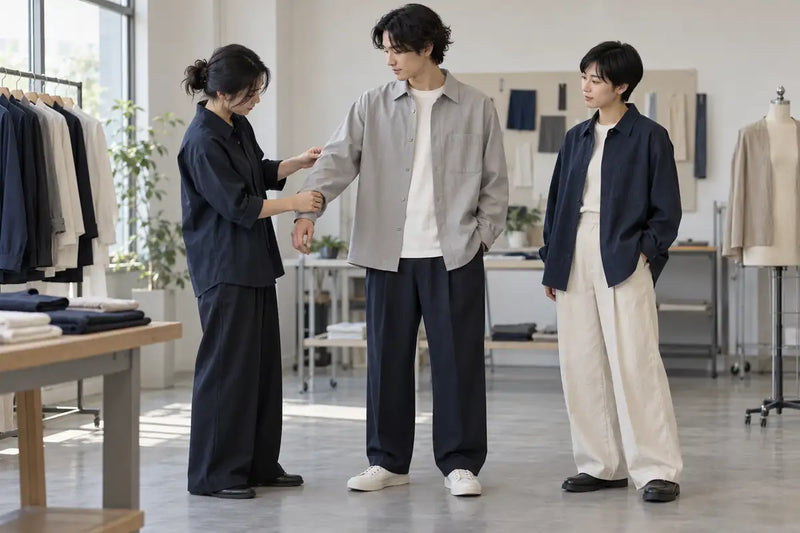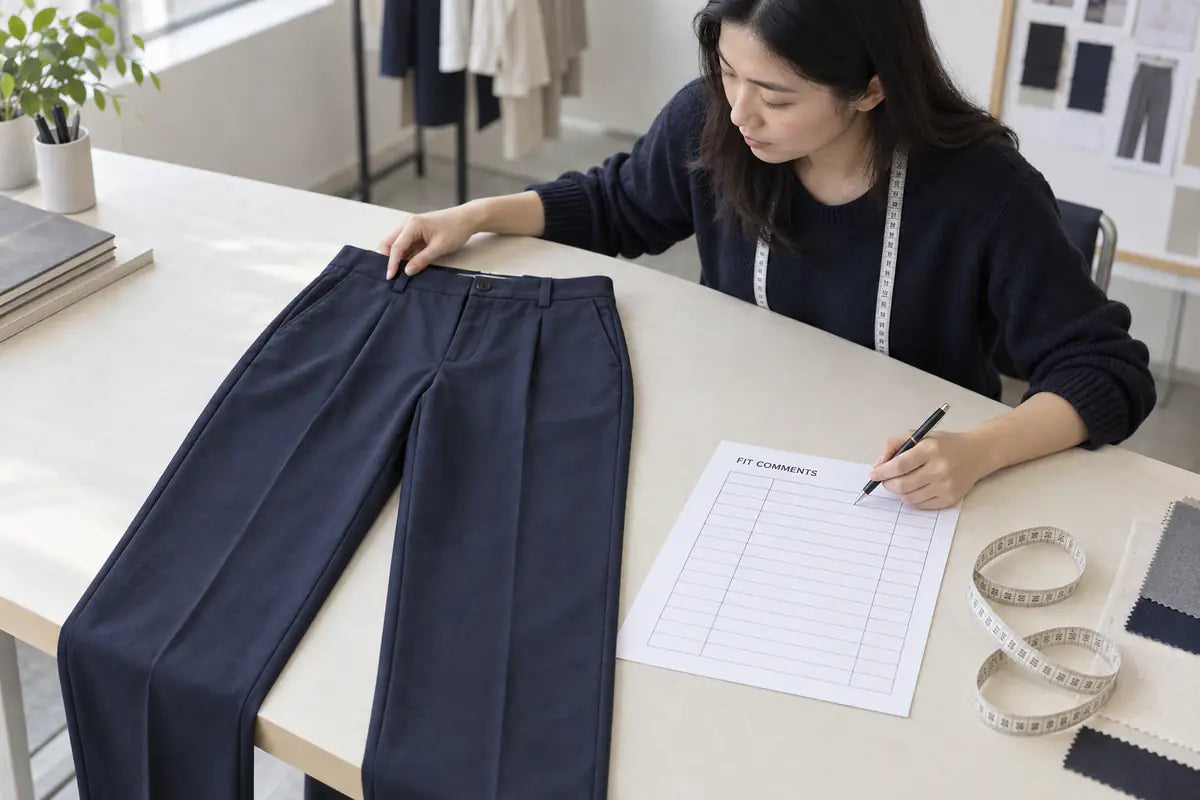
AI-generated editorial illustration; not a photograph of YJ staff, a customer project or a measured sample review.
A garment fit comments template connects your observations to a particular sample and the next action. If you write "make the waist smaller", the factory still needs to know how you measured it, the target you want and whether you are correcting an error or changing the design.
Use the copyable sample feedback record below to keep measured differences separate from design changes and fit observations. This original worksheet is for buyers to adapt with their supplier. It is not an industry-mandated form or a record of YJ's internal procedures.
Copy this garment fit comments template
Fill in the sample record once, then duplicate the individual comment block for each issue. Replace the blanks with your project information. Write "not applicable" where a field does not apply; leave an unresolved target as "to be confirmed" rather than guessing a number.
Sample review record
Style name / code: ____
Physical sample ID / round / size: ____
Factory / contact: ____Review date / reviewer: ____
Tech pack and measurement-guide revision reviewed: ____Fabric / color / trims used: ____
Known substitutions: ____
Condition reviewed, including any washing or pressing: ____Fit model or form reference: ____
Relevant body-measurement record / underlayers / footwear: ____
Movement or wear conditions checked: ____Review decision and exact scope: ____
Open issues / next sample or evidence requested: ____
Who may approve the next step: ____
Bulk production release: not granted by this review unless separately authorized.Attached photos / measurement sheet / revised sketches: ____
Individual fit comment
Comment ID / garment area / POM code if applicable: ____
Measurement method / unit / sample condition: ____
Existing specification target: ____
Allowed lower and upper deviation from target: ____
Actual sample measurement: ____
Difference, actual minus existing target: ____Fit or appearance observed, including movement: ____
Photo or sketch reference: ____Action type, choose one: return to existing specification / proposed design change / investigate before deciding.
Requested action and reason: ____
Confirmed next-sample target, or "to be confirmed": ____
Details that must stay unchanged: ____Supplier response / responsible person / agreed response date: ____
How the correction will be checked: ____
Status and sample revision used for closure: ____
Approval by / date / scope, if granted: ____
In your fit sample comments, keep the measured result separate from the decision about what to make next. Techpacker's sample fit table documentation likewise separates received measurements, tolerances, differences and revised specifications. You can maintain your own record in a document or spreadsheet; no particular software is required.
Identify the sample before discussing the fit
Put the same sample ID on the garment, comment sheet and photos. Include the size and round, not just the style name. If a later sample uses a different material, the earlier comments still belong to the version you reviewed.
Record which fit model or form you used and the conditions of the fitting. In Natalie Smith's guide to fitting a garment, sample identification and evaluation on a relevant form or model are part of the review. Keep only the personal information needed for fitting, and obtain permission before sharing identifiable photos.
Note any washing or alteration since the sample arrived. Keep an as-received reading separate from a post-wash measurement. If washing is part of the approval, agree the procedure and keep those records together; see our fabric and garment shrinkage testing guide.
State exactly how you measured it
Points of measure, often shortened to POMs, identify specific garment measurements. A shared POM and how-to-measure guide gives the buyer and factory the same reference for where and how to measure.
Write the unit and measurement basis. "Waist" could mean a body measurement, the garment's full circumference or a flat half-waist width. For an elasticated waistband, distinguish the agreed relaxed measurement from any stretched measurement. If a stretched reading is required, agree the method instead of letting each person pull to a different extent.
Keep the current target, measurement tolerance and actual reading in separate fields. For this worksheet, difference means actual minus target: a positive number is above the target, and a negative number is below it. The number records a difference. The requested action belongs in its own field; it may require investigation before anyone changes a pattern or target.
Example: clear comments on a pants sample
The following comments use a fictional sample, DEMO-PANTS-S2, size M. All measurements, tolerances, identifiers and requested changes are hypothetical. They are not YJ test results, size standards or recommended fit values.
F01: correct an out-of-tolerance measurement
Instead of "waist too big", write:
F01 / W01, half-waist width. Unwashed sample, closure fastened, measured flat without stretching at the position shown in measurement guide R2. Target 40.0 cm; permitted deviation -0.5 cm to +0.5 cm; actual 41.2 cm. Difference +1.2 cm, outside the allowed range of 39.5 cm to 40.5 cm. See photo F01-A.
Please recheck using the same method and investigate the discrepancy. Return the next sample to the existing 40.0 cm target. The target and tolerance are unchanged. Confirm the correction route before changing the pattern; submit the revised sample measurement for review.
The existing specification stays in place. The 41.2 cm reading is not accepted as the new target, and the factory still needs to determine the correction at pattern or sewing level.
F02: request a deliberate design change
Here the measurement is within tolerance, but the buyer wants a shorter design:
F02 / L01, inseam. Using guide R2: existing target 78.0 cm; permitted deviation -0.5 cm to +0.5 cm; actual 77.8 cm. Difference -0.2 cm, within tolerance.
Proposed design change for the next sample: inseam target 76.0 cm using the same method. Please confirm feasibility and any related changes for review before making the next sample. Keep the specified hem finish. This is a requested target revision, not a correction of an out-of-tolerance measurement.
The proposed target is 2.0 cm below the old specification and 1.8 cm below the measured sample. State the new target explicitly instead of sending only "shorten by 2 cm". Once agreed, update the specification revision and confirm the applicable tolerance.
F03: describe a fit problem without guessing its cause
F03 / seat and upper thigh. The wearer reports restriction when sitting in the agreed fit setup. See the sitting view F03-A and standing view F03-B. Please review the fit and propose a correction for approval. No measurement or pattern change is authorized for this point yet.
You can report discomfort without prescribing a pattern change. A sample can meet the listed measurements while still needing fit development. The women's pants fit and fabric guide covers related choices to assess together.
Use photos to support the written comment
Send an overall view and a close-up where needed, with each photo labeled by sample and comment ID. Show the posture or movement that produces the problem. For a detail with a left and right side, specify the wearer's side so a camera view does not reverse the instruction.
An arrow can locate the pocket opening or drag line. Add a comment explaining what you see and what you want the supplier to check. Smith's prototype-review guidance recommends annotated fit photos alongside written comments and updated technical sketches. Keep the original images too; do not retouch away the issue you need the supplier to assess.
Close each comment and define the approval
Send one consolidated set of comments from your team. If one reviewer requests a wider leg and another asks to narrow it, resolve that decision internally. Ask the supplier to flag unclear or conflicting instructions rather than choose between them.
On the next sample, reopen each unresolved comment and record the evidence used to close it. Record which details are accepted and which must stay unchanged. If the specification changes, identify the new revision and retain the previous one in the history.
Name exactly what each sample approval covers. "Fit accepted for sample S3, size M, against revision R4; fabric color and bulk release still pending" is more precise than "approved with comments". This is illustrative wording, not a release instruction for a real order. Confirm any size-set, materials, testing and pre-production approvals still needed before authorizing bulk.
Send YJ the sample and the feedback together
For a YJ project discussion, send your reference garment or sample photos, current specifications and one consolidated comment record. If you are beginning with an existing garment rather than a completed tech pack, our guide to working from a reference sample explains what still needs confirming.
Discuss your sampling requirements, including the review scope, material choices and unresolved fit questions. Agree the sampling arrangements and any revision work for the individual style.
Frequently asked questions
What should a garment fit comments template include?
Start with the sample ID and document revision. For each issue, name the garment area, record the measurement or fit observation, attach relevant evidence and request a clear next action. Finish with the review decision, open points and the person responsible for approving the next step.
How do I distinguish a measurement correction from a design change?
A correction asks the supplier to meet the existing target and tolerance. A design change proposes a different target or detail even if the sample was made to specification. Record the actual measurement separately, and approve the revised specification before it becomes the instruction for the next sample.
Should fit comments use flat measurements or full circumference?
Use the basis defined for that POM in your agreed measurement guide and label it clearly. Do not mix a flat half-width, a full garment circumference and a body measurement under the same field name. State units and any relaxed or stretched condition.
Can I give useful sample feedback without knowing pattern making?
Yes. Explain where and when the issue appears, what you want to improve and what you measured or photographed. You can ask the technical designer or supplier to investigate and propose a correction without prescribing the pattern change yourself.
Does approving the fit sample approve bulk production?
Not automatically. Name what is approved and what is still open, such as other sizes, materials, construction or testing. Record bulk-production authorization separately according to the agreed project process.