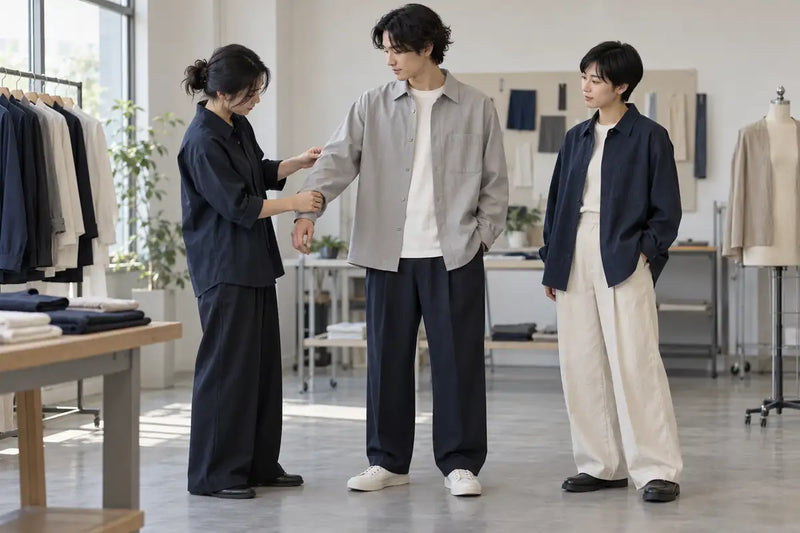
AI-generated editorial illustration with fictional people and sample garments; not a photograph of a customer return, YJ staff or a verified quality inspection result.
Use clothing return reasons to decide what needs investigation before you change the next production run. A customer who selects "too small" might mean a tight waistband, a short rise or a fit that differs from the product photos. You would not fix each of those problems with the same pattern change.
Record the issue and compare it with the garment and agreed specification. Then test the proposed correction before bulk production. Keep listing, packing and delivery problems separate from manufacturing changes.
Record the customer's reason and your finding separately
Put the feedback in a return log that the team can review consistently. ASQ's check-sheet guidance recommends defining what you are observing and the collection period before recording repeated events. For apparel returns, adapt that approach to individual returned units and their original orders.
Record the style, size, color, original order line, delivered quantity and dates. Add a batch or production reference where available, the returned quantity, return status, customer-selected reason and original comment. Do not guess a batch when inventory records cannot identify it.
Keep inspection findings in a separate field: for example, "waist measures below the agreed tolerance," "within specification" or "not yet inspected." Note whether the garment was worn or washed, and whether its care history is known. Remove customer names, addresses and unrelated personal information from the summary you send to the factory.
Define categories such as fit, fabric feel, construction, appearance, wrong item, delivery and changed mind. Keep "unknown" available. If one unit has several complaints, retain the extra tags but use a defined primary reason for a non-overlapping reason count. Leave a vague comment unresolved until you have evidence to classify it.
Compare rates as well as return counts
A popular size can generate more returns simply because more units were delivered. For a production review, define a group of delivered units from the same style revision and period, then follow returns from those units. Use the same return-observation window after delivery for each comparison group and allow processing time before calling the results complete.
For this review, count units received back as returns, keeping open requests and refund-only cases separate. The unit return rate is returned units from that group divided by units delivered in that group, multiplied by 100. Count each delivered unit once in the numerator, even if an exchange and refund create several records. Do not mix units with orders, refund value or net sales. A reason-specific rate uses returned units assigned that primary reason over the same delivered-unit denominator.
Hypothetical example: size M has 8 fit-related returns from 200 delivered units, or 4%. Size L has 4 from 50, or 8%, after equal observation windows. M has more returned pieces; L has the higher observed fit-return rate. The smaller L sample still needs investigation, and these figures do not prove a grading fault. They are not YJ results or industry benchmarks.
The share of returns marked "fit" answers a different question: how much of the return pool carries that reason. It does not tell you the chance that a delivered garment comes back. Label both measures clearly, show their counts and avoid ranking tiny groups as if their rates were stable.
Choose what to investigate before choosing a fix
Review the data by style, size, color and traceable batch. If a problem clusters in one group, look for differences in material, specifications, production or fulfillment records. Investigate those differences before assigning a cause or responsibility.
A frequency or cost ranking can help choose where to start. ASQ's Pareto-chart guidance describes ranking categories by their measured contribution. Use the actual figures rather than assuming an 80/20 split. Also consider severity: a suspected safety issue needs prompt escalation and an assessment of affected stock, even if it appears only once. Do not wait for the next production run.
Translate complaints into garment checks
Use the following examples to plan checks. The comment alone cannot establish the cause or the right fix.
| Return comment | What to check | Possible action if supported |
|---|---|---|
| "The waist is too tight" | Correct size label, agreed waist measurement, stretch condition, fit reference and listing | Correct an out-of-spec garment process, review the fit target or clarify size guidance |
| "It became shorter after washing" | Care history and controlled before-and-after measurements on a representative sample | Review material or finishing options and retest the finished garment |
| "The seam opened" | Failure location, stitching, seam allowance, fabric damage and use history | Trial a supported construction or process correction and check its performance |
| "The fabric is not what I expected" | Approved material, actual garment, opacity or feel concern, photos and description | Correct a material mismatch or review the specification and product presentation |
| "I received the wrong size" | Order line, garment label, measured size and packing record | Correct the identified labeling or picking step, not the pattern by default |
Compare returned garments with retained production samples and the approved specification where possible. Use the agreed measurement method and tolerances. If the garment matches the target but customers consistently dislike the fit, review whether the target suits them. Keep that finding separate from a garment that misses the agreed measurement.
For wash-related complaints, do not infer the original dimensions from a worn return alone. CottonWorks' shrinkage guidance identifies material, processing, construction and care as contributing factors for cotton products. Agree a suitable test with the supplier. Our fabric and garment shrinkage guide explains the records to keep.
Send the factory an evidence-based change brief
ASQ's root-cause analysis guidance treats cause investigation as part of a wider improvement process. The return comment describes the reported problem. Before asking the factory to change something, provide supporting evidence and agree how to check the result.
For each issue you want addressed in the next run, send the supplier:
- The affected style revision, sizes, colors and known batches, with delivered and returned counts.
- The customer's observation, your inspection result and relevant photos or samples.
- The current specification, measurement method and approved reference.
- The proposed investigation or change, including what must remain unchanged.
- The person responsible, sample or test acceptance criteria, approval owner and required decision date.
Use a garment fit comments record for measurement and sample feedback. "Improve quality" is not enough to tell a patternmaker or sewing team what to do. If the cause remains uncertain, request an investigation or trial rather than presenting a suspected fix as settled.
Decide what to do with current stock separately from the changes planned for the next run. Our garment rework guide discusses correction and rechecking; it does not mean every returned garment can be repaired or establish a refund arrangement.
Approve the change and check the next run
Review the revised sample in the intended materials. Recheck affected sizes and connected details: a waist change, for instance, may need another review of the closure and hip fit. Where practical, keep unrelated variables stable so you can assess the proposed change. Record every change when several must happen together.
After approval, update the specification revision, approved sample reference and relevant garment quality control checks. Agree who confirms that the factory is using those references before bulk release. A corrected sample alone does not verify every production piece.
Follow the next batch using the same reason definitions, unit denominator and observation window. Compare the targeted problem as well as overall returns, allowing for changes in size mix, sales channel, product listing or return policy. A lower overall return rate alone does not establish that the production change worked. Record unresolved issues and any new ones.
Prepare production feedback before placing the reorder
To discuss a YJ reorder or development project, send your production feedback and next-run brief. Include an anonymized issue summary, relevant measurements, sample references and the quantities you are considering. Ask to confirm the investigation scope, sampling, costs, timing and inspection requirements for that project.
Put the agreed revisions and checks into the next order so the production team knows what to change and how the result will be verified.
Frequently asked questions
Does a high clothing return rate mean the factory made defective garments?
No. Fit expectations, product presentation, fulfillment and customer preference can all lead to returns, as can defects. Check the reason against the garment and agreed specification before assigning a cause. A garment can meet the specification and still need a design review for its intended customer.
How should I calculate a return rate for a production review?
Choose a defined group of delivered units and follow its returns over a consistent observation window. For the measure used here, divide units received back from that group by its delivered units and multiply by 100. Keep open requests and refund-only cases separate, and deduplicate records for the same unit.
Should I change the size chart when customers select too small?
Investigate first. Confirm the ordered and labeled size, relevant garment measurements, approved fit and published guidance. A manufacturing deviation, an unsuitable fit target and unclear sizing information need different actions. Do not enlarge every size from the return code alone.
How many complaints do I need before changing production?
There is no fixed count. Look at severity, repeated findings, delivered volume and the evidence behind the comments. A serious concern may need immediate action; a few vague comments may need more inspection. Keep the uncertainty visible when the sample is small.
What should the manufacturer receive with return feedback?
Send a style and batch reference where known, affected sizes and colors, delivered and returned counts, anonymized comments, inspection findings and useful photos or samples. Include the current specification and the investigation or change you want reviewed. Confirm sample approval and recheck requirements.