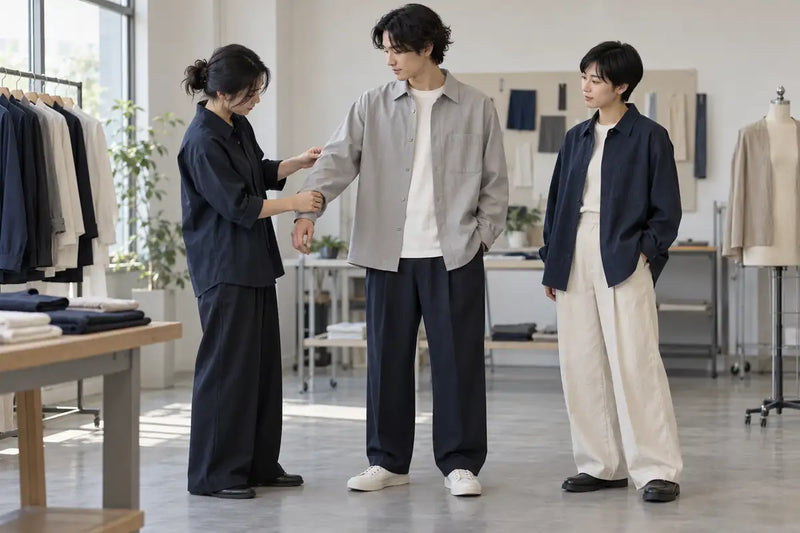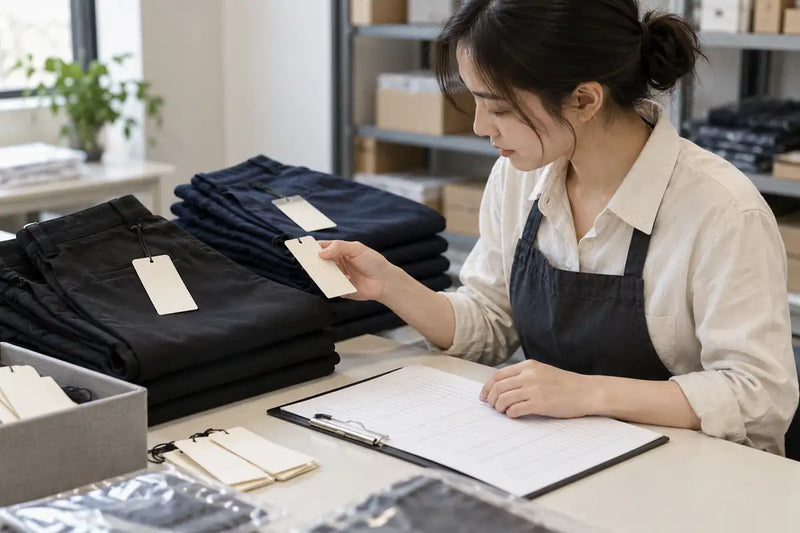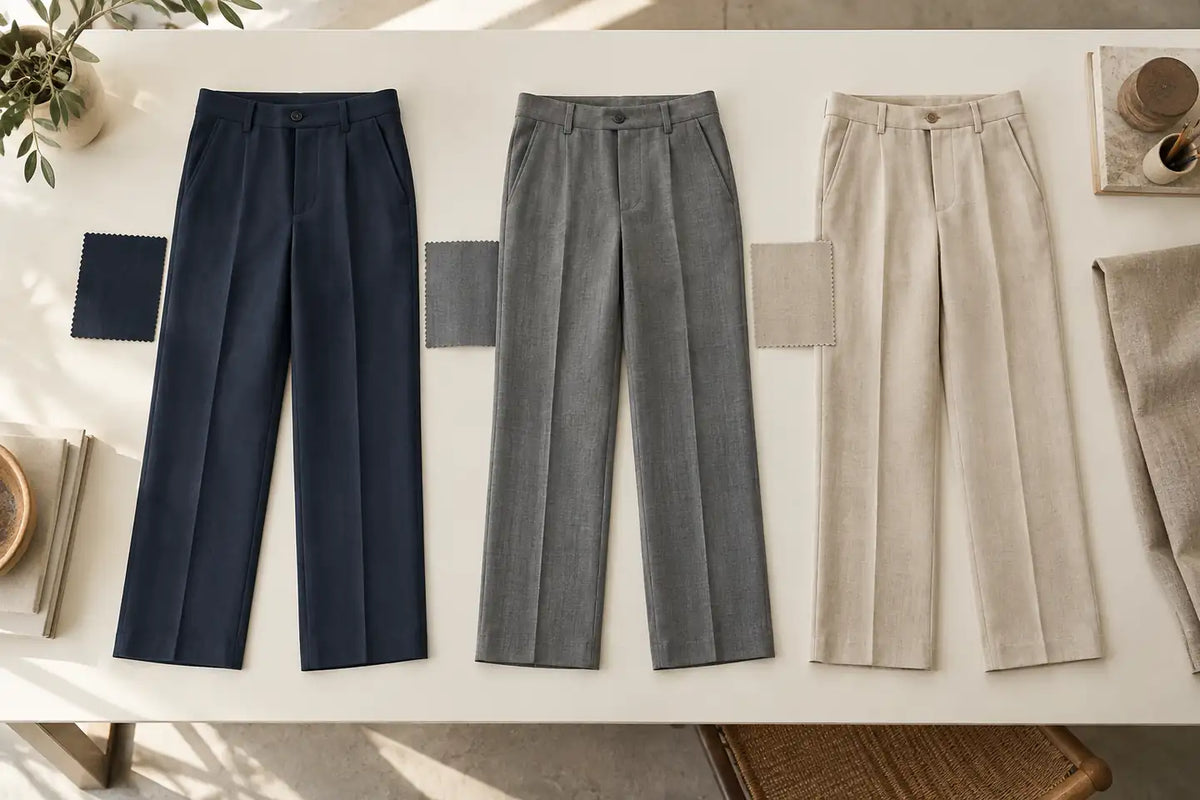
Images in this article are AI-generated illustrations, not photographs of YJ products or facilities.
The same pants style can have different minimum order quantities because each fabric comes with its own purchasing and production conditions. One option may already be available in the required color. Another may need a new weaving, knitting, dyeing, or finishing run before the garment factory can cut it.
Reusing the pants design may reduce development work, but it does not remove the fabric MOQ. The factory must also consider how much material each pair needs and whether it can accept a small sewing run.
When two fabric options come back with different minimums, ask which requirement is setting the quantity: garment production, fabric purchasing, color processing, or another component. That answer tells you what can be changed.
Separate the pants manufacturing MOQ from the fabric MOQ
A quote can contain several minimums. Confirm what each one applies to and the unit used:
- Garment minimum: the number of finished pairs accepted for a style, fabric, or color under the factory's terms.
- Fabric minimum order quantity: the amount of a specified material that must be purchased or produced, often measured in meters, yards, kilograms, or rolls.
- Minimum per color: the quantity required for an individual shade, sometimes called MCQ or minimum color quantity.
- Other minimums: quantities or batch charges for trims, prints, washes, or finishing operations required by the order.
Check all of these requirements against the same order. A factory willing to sew a small number of pants may still need to purchase more fabric than those pants will use. The buyer and supplier then need to agree on the extra material, a surcharge, or a different order plan.
Stock fabric and custom fabric follow different purchasing routes
With finished stock fabric, the supplier has already made and colored the material. A buyer can potentially purchase part of that stock, subject to availability and the seller's cutting or roll terms. A swatch book alone does not confirm that the required quantity is available.
For example, MTK Australia's fabric FAQ states that its stock range has no minimum quantity, while its bulk knitted fabric orders depend on fabric quality and weight. It also allows smaller bulk quantities with a surcharge in some circumstances. These are that supplier's terms, rather than a standard available from every mill.
Custom fabric may require yarn purchasing, machine preparation, and a dedicated production run. Even an existing base fabric can need another processing batch if you request a new color or finish. Ask whether the option is finished stock, undyed fabric awaiting processing, or material that has yet to be woven or knitted.
Stock can make a first order easier to arrange, but check the reorder plan. A continuing stock program and a limited surplus lot offer different prospects for obtaining the same fabric again.

Why changing color can change the minimum
A total fabric minimum and an MOQ per color can apply to the same purchase. Meeting one does not automatically satisfy the other.
KenDor Textiles' published order minimums illustrate the distinction: custom colors on its existing fabrics usually require 300 to 500 meters per color. For fabrics outside its existing offering, it lists varying total minimums alongside usual per-color minimums. Those figures describe KenDor's offering and are not YJ requirements.
If a quoted minimum is per color, splitting the pants into black, navy, and beige creates separate color requirements. An approved black option already in stock may have different terms from a beige shade that needs custom dyeing, even when both use the same base construction.
Ask for the minimum and availability of each exact fabric-and-color combination. Do not assume that a total collection quantity can be divided into any color ratio.
Fiber names do not tell you the MOQ
There is no dependable rule that cotton pants always have a lower MOQ than linen pants, or that polyester always allows a smaller order. The specific fabric, supplier, color, and purchasing route determine the material commitment.
Compare the fabric article codes and specifications. Composition is only one part of the description. Yarn, weave or knit construction, weight, width, stretch, color, and finish may differ between two swatches with the same fiber name.
A premium fabric available from stock could have a lower purchasing minimum than a cheaper material made specifically for the order. Unit price and minimum quantity answer different questions. The low MOQ clothing cost guide explains how they affect total order spending.
The same pants design may use different amounts of fabric
The mill sells material in its own units; the garment factory must translate that purchase into a production plan. Ask for the estimated consumption per pair based on the actual size breakdown and usable fabric width.
The cutting layout, called a marker, arranges the pants pattern pieces across that width. A different width, a directional surface, or a pattern that needs matching can change the layout and the material needed. Keep cutting losses and other allowances visible in the calculation.
Fabric behavior also affects fit and pattern decisions. CottonWorks' shrinkage guidance explains that construction, dyeing, finishing, and garment processing can affect dimensional change. Check the replacement fabric through sampling before assuming an approved pants pattern can be used unchanged.
If the mill quotes kilograms, request the corresponding length using that fabric's weight and width. There is no single conversion from kilograms to meters or from a roll to pairs of pants. The clothing manufacturing process guide explains where pattern preparation, cutting, and production checks fit into the order.
A worked example: 100 pairs in two fabric options
The following numbers are invented to explain the difference between buying fabric and ordering garments. They are not YJ quotes, supplier terms, or industry averages.
Assume the factory accepts 100 pairs in one style and one color for either option. Assume both options need 1.8 meters per pair, including the planning allowances, and that the seller permits the exact purchase lengths shown. In a real quote, consumption and roll rounding would need checking for each fabric.
| Item | Fabric A: finished stock | Fabric B: custom dyed |
|---|---|---|
| Fabric purchase minimum for the chosen color | 50 meters | 600 meters |
| Planned garment quantity | 100 pairs | 100 pairs |
| Planned fabric requirement | 100 × 1.8 = 180 meters | 100 × 1.8 = 180 meters |
| Fabric purchased under these assumptions | 180 meters | 600 meters |
| Balance beyond the planned requirement | 0 meters | 420 meters |
Fabric B creates a larger material commitment. It does not automatically force the brand to manufacture more than 100 pairs. Keeping the garment order at that quantity depends on an agreement about purchasing and holding the extra fabric.
The supplier might instead propose a larger garment run, a smaller fabric batch with a surcharge if available, or an alternative material. Ask who owns unused fabric, where it will be stored, whether storage costs apply, and how it can be used for a repeat order. The balance is a planning estimate; actual consumption and production losses must be reconciled afterward.
Dividing the fabric minimum by consumption per pair estimates how many pairs that material could support. The factory still needs to agree on the quantity it will manufacture and the terms for handling any unused fabric.
Can several styles share one fabric minimum?
Sometimes, if the supplier accepts a combined material purchase. Pants, shorts, and a matching jacket may share the same fabric article, color, and finish. Their combined consumption can help meet the material minimum, while each garment style still has its own production conditions.
Both styles must use material that the supplier agrees to purchase together. Similar-looking fabrics, different weights, or separate custom shades cannot simply be counted as one fabric order without the supplier's agreement. Confirm the allocation by style and the delivery schedule before committing.
How to compare options when you need a smaller pants order
Start with the product requirements that must stay fixed, such as fit, opacity, stretch, and care performance. Then ask the supplier to review alternatives you would actually accept:
- The same fabric in an available stock color
- A stock fabric with an acceptable specification, subject to sample approval
- Fewer custom colors while preserving the intended size range
- A shared fabric purchase across compatible styles
- A smaller processing batch with its quoted surcharge
- A separate material purchase with agreed ownership and storage for the balance
Compare the complete commitment: garments, excess fabric, development, surcharges, and any storage costs. A lower garment MOQ can still require a larger material payment. Check samples through the sampling and production process before choosing a replacement fabric solely for its minimum.
What to ask when two fabric quotes show different MOQs
Send the supplier the same pants brief and identify each proposed fabric by article code or traceable swatch. Include composition, weight, usable width, color, finish, quantities by size, and any required wash or performance checks.
Ask for the following information against each option:
- Is the fabric finished stock, undyed stock, or new production?
- What is the garment minimum, and what style or color grouping does it apply to?
- What are the fabric minimum and per-color minimum, with their units?
- How much material is allowed per pair, and which losses are included?
- Are there separate trim or processing minimums?
- Can the intended garment quantity proceed with a surcharge or extra fabric purchase?
- Who pays for and owns any balance, and what are the reorder terms?
Use the project inquiry form to request a comparison for the same pants style in your preferred fabrics. Request the requirement behind each minimum and the total purchase involved. If your intended quantity is too low, ask which fabric or purchasing changes would make it feasible.
Frequently asked questions
Why does the same pants style have different MOQs in different fabrics?
Each fabric can have different stock availability, production minimums, color requirements, and consumption per pair. Reusing the pants design does not remove those material conditions. Ask the supplier which requirement is setting the minimum for each fabric option.
Is fabric MOQ the same as garment MOQ?
No. Fabric MOQ is the minimum material purchase or production quantity, measured in units such as meters or kilograms. Garment MOQ is the accepted quantity of finished pieces under the factory's terms. A small garment order may still require a larger fabric purchase.
Does linen always require a higher MOQ than cotton?
No. A stock linen option may allow a smaller material purchase than a custom cotton option, or the reverse. Compare the exact fabric article, color, specification, and sourcing terms instead of ranking minimums by fiber name.
Can different pants colors be combined to meet the MOQ?
Only under the supplier's agreed terms. An overall fabric minimum and a separate per-color minimum may both apply. Confirm the required quantity for each shade and whether the proposed color allocation is accepted.
Can I order fewer pants and pay for the extra fabric?
That may be possible if the garment factory accepts the sewing quantity and both parties agree on the material purchase. Confirm ownership, storage costs, identification of the fabric balance, and the conditions for using it later.
Does a lower fabric MOQ mean a lower total cost?
Not necessarily. Compare the garment bill, material price, any excess fabric, small-batch surcharges, sampling, and storage. A smaller commitment can also change the unit price, so request an itemized comparison.