AI-generated editorial illustration; not a photograph of YJ facilities, a customer order or a measured test result.
Garment twisting after washing can leave a T-shirt side seam moving toward the front or a pants seam turning around the leg. It can reflect stresses released in the fabric during laundering, rather than a garment simply becoming smaller. The visible twist alone does not tell you which production stage caused it.
Compare the same sample before and after the agreed washing and drying conditions. Show the supplier where the seam moved and keep the measurements with the photos. Decide what the garment must meet before you approve bulk production.
Separate twisting from shrinkage and surface wrinkles
Look at the panel and seam positions, not just the garment's overall length. A shorter inseam is a dimensional change. A seam rotating around the leg is a different observation. A garment can show both, so passing a shrinkage check does not settle a twisting complaint. Keep the results separate in your fabric and garment shrinkage review.
Fabric skew describes an angular misalignment in the fabric structure; bow describes a curved path across it. Garment spirality or torque concerns rotation in the garment. When a supplier reports a 'skew' result, ask which of these they measured. CottonWorks' skewing presentation illustrates these distinctions in woven and knitted materials.
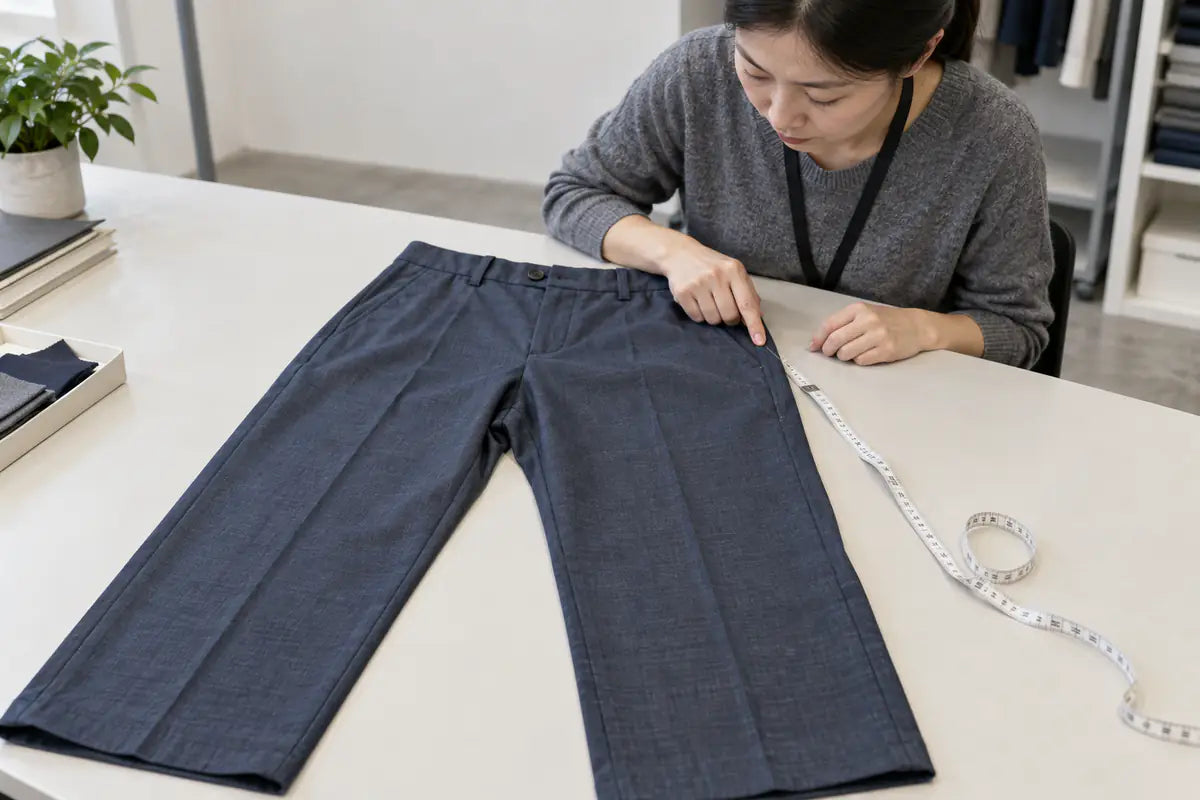
Photograph the sample in a consistent position before washing and again after the specified drying and conditioning. Follow the selected method when laying out and measuring it. Do not pull seams straight for the after-photo or confuse a packing crease with a change in panel alignment.
Why garments can twist after washing
Yarn and knitted structure
In single jersey, yarn twist liveliness can contribute to the rotation of the knitted structure. CottonWorks explains how this can appear as displaced stitch columns or rows. A seam that looked straight before washing may therefore move even without an obvious sewing defect. Fiber composition alone cannot establish how a particular garment will behave.
Skew control in denim and other fabric processing
For denim, an apparently skewed fabric is not automatically evidence of an error. Pre-skewing can be part of fabric finishing to manage later leg twist. CottonWorks' skewing Q&A explains that either too little or too much pre-skewing can leave a problem. Ask the mill to base any correction on test results.
Ask about the fabric's processing history too. CottonWorks' dimensional-stability guidance identifies construction, processing tension and finishing as influences on fabric behavior. Ask what condition the tested material was in and whether it had received the finish intended for your order.
Cutting and assembly need investigation too
Ask the factory to compare the cut panels with the pattern's intended grainlines and review fabric handling during spreading and cutting. Where the distortion is concentrated at a seam, ask the factory to review panel matching and sewing conditions as well. A photograph alone cannot establish that the fabric mill or the sewing operator is at fault.
Changing the cutting angle just to make an unwashed stripe look straight is not proof of a correction. CottonWorks' Q&A warns that this approach can leave the fabric's wash-related skew unresolved. Check the revised garment after care before accepting the change.
Choose a test that answers the right question
Ask the test provider whether the requirement concerns the fabric's skew change or the finished garment's seam rotation. AATCC's explanation of method scope distinguishes those assessments. The following methods address different parts of the problem:
| Method | What it assesses |
|---|---|
| AATCC TM179 | Change in fabric skew after home laundering. |
| AATCC TM207 | Garment seam twist before and after home laundering. |
| ISO 16322-3 | Spirality or torque of woven and knitted garments after domestic laundering. |
ISO 16322-3 cautions that results from different procedures might not be comparable. Do not compare two percentages without checking the method, procedure and calculation basis. The test provider should select a suitable current method and follow its full instructions; this overview is not a test procedure.
A fabric swatch cannot show how the assembled pants will sit after washing. Check a sample with the intended construction when the concern is seam or leg rotation. If the style has a production garment wash, identify whether the test sample has already completed it. The manufacturing wash and later consumer laundering should not be treated as the same approval stage.
Put the wash-testing requirements in writing
Before testing, write down what the sample represents and how the result will be judged:
- The style, size, color, fabric reference and material lot represented by each sample.
- The sample's finishing state, including any production wash or temporary substitute component.
- The test method and edition, selected procedure, washing and drying conditions, and cycle count.
- The preparation, conditioning, reference marks and measurements required by that method.
- The acceptance limit, reporting convention and any separate appearance or fit requirements.
- Who will review the report and authorize the next production step.
Choose conditions appropriate to the intended care instructions. If a separate harsher trial is requested, label it separately rather than presenting it as the same test. An informal development wash can reveal a concern, but it should not be described as standards-compliant testing unless the relevant requirements were followed.
Agree which bulk lots or colorways need coverage. Keep the result tied to the material tested; it does not automatically cover every roll or later order. If the material or finishing route changes, decide what must be tested again as part of sample and production approval.
How much twisting is acceptable?
Do not adopt a percentage from another supplier's report as a universal pass limit. Set the requirement for the garment, intended care and selected measurement method. CottonWorks' Q&A explicitly distinguishes a commonly requested percentage from an industry standard.
Compare the reported result with the tested garment. For pants, check where the side seam or inseam ends up and whether the change affects the intended fit and appearance. Keep the original readings and photos with the result, including the direction of movement where the method requires it. A small change during a test should not be used to excuse an unacceptable starting appearance.
What to do when a sample fails
Pause approval of the affected sample or goods against the failed requirement. Confirm that the sample identity and wash conditions match the order before deciding what to correct. If the supplier proposes changing the material or finish, ask why that would address the problem. Ask the same question about an assembly adjustment.
- Identify the affected material or production group and preserve the test sample and report.
- Agree a corrective trial with the supplier instead of authorizing an untested change across the order.
- Repeat the relevant wash testing on the corrected version and recheck fit, measurements and appearance.
- Record the outcome and any remaining issue before deciding whether to accept the goods.
Do not accept a freshly pressed photograph as evidence that the garment will remain straight after washing. If the distortion starts in the fabric, opening and re-sewing a seam may leave the cause untouched. Some pieces may not be recoverable to the agreed requirement. Discuss that possibility, along with quantity, timing and cost, before approving rework.
Our garment rework guide explains correction and customer communication. Record any customer acceptance of a minor appearance issue against the specific goods concerned. It does not extend to future twisting problems.
What to send for a YJ project discussion
Send the garment reference, fabric information, intended care instructions and your requirements for appearance after washing. If you already have a twisting concern, include before-and-after photos, the report and details of the treatment used. YJ's sampling and quality-control arrangements need confirmation for the individual project.
Discuss your clothing production requirements before bulk approval, including which checks are needed and how a failed result should be handled.
Frequently asked questions
Is garment twisting after washing the same as shrinkage?
No. Shrinkage describes a reduction in dimensions, while twisting concerns a change in alignment or rotation. A garment can show both. Check measurements and seam positions separately rather than assuming that a passing shrinkage result covers twisting.
Does a twisted side seam prove poor sewing?
A rotated seam alone does not prove a sewing fault. The fabric can move during laundering too. Ask the supplier to review the material, intended grainlines and assembly before agreeing on a correction.
Is garment spirality only a problem in knitted clothing?
No. Knitted structures can show spirality, but woven garments can also develop rotation, including leg twist in denim. The material and garment construction determine what the supplier needs to investigate.
Is there one acceptable twisting percentage for every garment?
No single percentage should be assumed to approve every style. Agree on the test method, procedure, care conditions and acceptance requirement. Results obtained using different procedures may not be directly comparable.
Can ironing or re-sewing fix a garment that twists?
Do not assume that a better appearance after pressing or repair means the problem is solved. Find the cause, try the proposed correction and repeat the relevant care test before accepting the result.
Should wash testing be repeated after changing the fabric?
Review the test plan whenever the material or finishing route changes. The earlier sample no longer establishes the new version's performance. Agree which checks and sample approvals are needed before the revised garment enters bulk production.