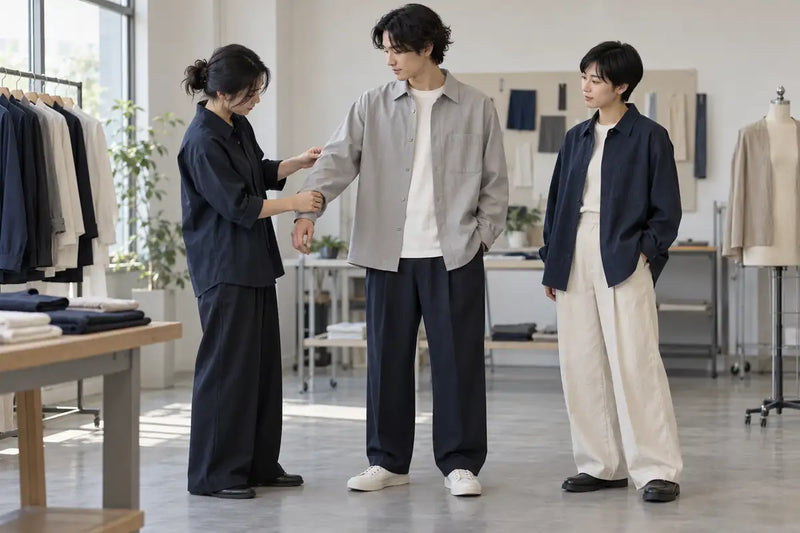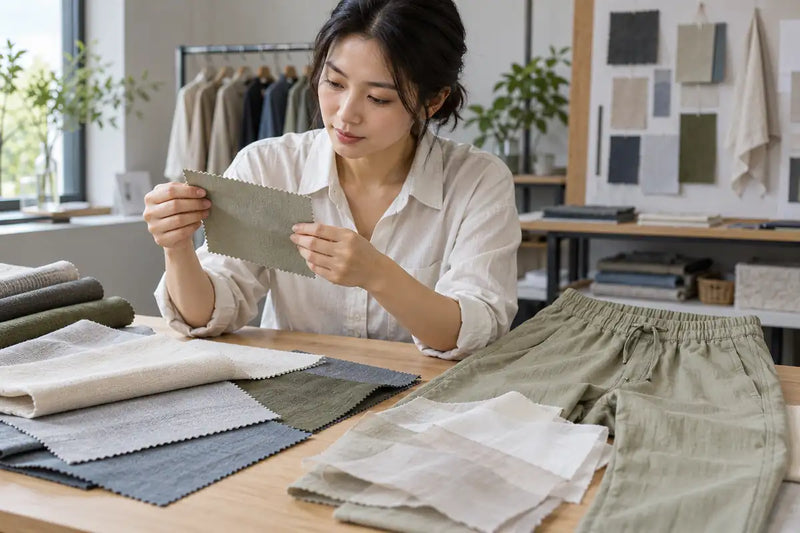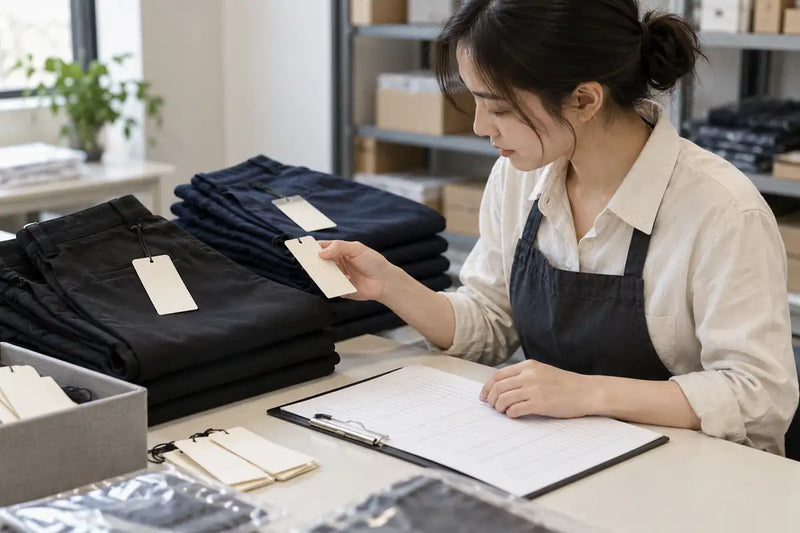
Cover image: AI-generated illustration, not a photograph of YJ staff, a YJ facility or a customer project.
For a brand buying custom women's pants, a style photo and a size label leave too much open. The brief also needs to say who the pants should fit, how the fabric should behave and what the finished sample should look and feel like.
The brief and sample reviews should lead to a product you can repeat across a size range. Record the version you approve before bulk production and identify any unresolved details as open items.
Describe the pants you want to make
Give your women's pants manufacturer a reference silhouette and explain the details that matter: where the waistband sits, the room through the seat and thigh, the leg shape, the length and the closure. Even with a wide-leg style, you still need to specify how closely the pants should fit through the hip and thigh.
A target body measurement chart and fit references give the supplier more to work with than a label such as "European fit." If you already have a garment whose fit works for your brand, explain which parts you want to retain and which need to change.
For private label women's pants, clarify whether the project uses an existing supplier pattern, modifies that pattern or requires a new one. If you do not have a tech pack yet, agree on who will prepare the measurements and construction specifications.
Keep body measurements separate from garment measurements
Body measurements describe the intended wearer. Finished garment measurements describe the pants. You need to account for movement and the intended silhouette when deciding the garment dimensions. Copying the body measurements directly into a production specification can give you the wrong fit.
New Mexico State University's pants measurement guide records measurements for the waist, hips, thigh and crotch, and treats body dimensions and ease separately. Work out the ease with your pattern maker using the selected fabric; one allowance will not suit every cut.
Draw up a points-of-measure sheet so both sides can measure the pants the same way. State the unit, how the pants are laid out, whether a width is measured flat or as a full circumference, and whether the waistband is included in vertical measurements. Define these areas before reviewing sample measurements:
| Measurement area | What to define on the specification |
|---|---|
| Waistband | Measurement position and flat width or circumference; for elastic waists, the agreed relaxed and extended measurement conditions. |
| Hip | Width or circumference and the exact distance below the chosen waistband reference. |
| Front and back rise | The separate measurement paths and endpoints, including how the waistband is treated. |
| Thigh and knee | Width at specified positions, so different reviewers measure the same places. |
| Inseam and outer length | Start and end points, finished hem position and waistband inclusion. |
| Leg opening | Finished opening width, with any slit, cuff or turn-up detail recorded. |
Agree on a tolerance for each relevant measurement and the stage at which it applies, such as after the specified garment wash. Make clear whether the chart describes an unfinished sample or the pants ready to pack.
Review women's pants fit in movement and across sizes
Use a fit model whose measurements correspond to the target size, and record those measurements with the sample version. Review the front, side and back while standing, then have the wearer sit, walk and bend as appropriate for the product. Check waistband comfort, pulling through the crotch, pocket opening and whether the legs hang as intended.
Write fit comments around what you see and feel. For example, "the back waistband gaps when seated" gives the pattern maker more to investigate than "make the waist better." Mark the location, include photographs and let the pattern maker assess the correction. Changing one width may not address the cause of the problem.
For pull-on pants, check that the opening passes over the hips comfortably as well as fitting at the waist. For a fly-front style, operate the closure while wearing the garment. Review the intended hem length with the type of footwear specified in the brief.
After approving the base size, review the grading rules, which specify how each measurement changes between sizes. Do not assume every point should increase by the same amount. Agree which additional sizes need samples, including sizes where you expect the fit to be hardest to maintain. If the range includes petite or tall lengths, document those proportions separately.
The sampling and production process is the place to define these approvals. Keep base-size approval separate from approval of sizes you have not checked.
Make pants fabric selection part of the fit review
Keep a physical fabric reference alongside the composition, construction, weight and finish specifications. Include the required stretch direction where relevant. A fiber name such as linen, lyocell or polyester does not fully describe how a particular fabric will work in the pants.
Weight is only part of drape. CottonWorks' explanation of digital fabric describes measuring thickness, weight, bending and stretching to simulate how cloth hangs. For a buyer, that is a reason to treat GSM, or grams per square meter, as only part of the specification. Compare actual fabrics in the intended garment instead of assuming a heavier option will always drape better.
With a fluid wide-leg style, look at how the leg falls and whether pockets or hems interrupt it. For a more structured trouser, check whether the fabric holds the intended shape without feeling too stiff for the brief. Check light colors for show-through on the sample, including the appearance of pocket bags and any lining, under agreed lighting.
Check recovery as well as stretch
A fabric that stretches easily does not necessarily return fully to its original shape. ASTM's overview of woven stretch-fabric testing distinguishes stretch, growth and recovery. Ask about each property separately. The elastane percentage alone does not tell you how the fabric will perform.
Review the sample after movement for changes around the knee and seat. Where measured performance is needed, agree with a lab on a method suitable for the fabric and purpose, including the direction and conditions of testing. ASTM cautions against using that particular method to accept commercial shipments, so the linked overview is not a ready-made specification for your order.
If you change the fabric after fit approval, make and review a sample in the replacement. Keep a record of any effect on fit, drape, opacity and the agreed care checks. Check whether the pattern still works before carrying the approval forward.
Check the intended care and color performance
Decide how the finished pants should be cared for, then agree on the checks needed for that use. Compare garment measurements and appearance before and after the agreed treatment. Our fabric shrinkage test guide explains why fabric results and finished garment checks have different roles.
A shade sample can confirm the color you want. It does not show how readily that color transfers to another surface. AATCC's crocking test overview addresses color transfer through dry and wet rubbing and notes that treatment such as washing or finishing can change the result. Decide which colorfastness checks the product needs, when to test and what result you will accept. Rubbing covers only one aspect of colorfastness.
Review pants finishing inside and out
Review the sample inside and out after the production wash or finish you have specified. Look along the side seams and inseams for unintended waviness, check that hems lie as intended and inspect the waistband for twisting or unevenness. Compare left and right sides against the approved design.
If a seam puckers, ask the supplier to investigate the cause before pressing it again. Coats' technical guide to seam puckering identifies several possible contributors, including thread tension, fabric structure, feeding differences and dimensional changes during later treatment. If a seam looks smooth only immediately after pressing, investigate before approving it.
Agree on the seam construction and stitch appearance for the chosen fabric. Specify where reinforcement is required, such as pocket openings or belt loops, and inspect the sample for skipped stitches, loose ends and unwanted bulk. A neat-looking seam alone does not establish its strength; discuss any performance testing separately.
Operate zippers, hooks and buttons. Check pocket depth and access, how pocket bags lie, and whether the trims feel uncomfortable against the body. Check the agreed label artwork, placement and care information on the sample as well as in the digital layout.
For the final appearance, define whether you want a pressed crease, garment wash or particular surface feel. Compare the finished appearance with the approved reference, looking for unwanted press shine, impressions, stains and packing creases. Use the quality control requirements to agree on inspection scope and how defects will be reported and handled.
Record the approval before bulk production
Identify the pre-production sample by style code, size and revision. Note the fabric reference, color, trims and finishing used. List any substitute as an open item. Otherwise, a general "approved" message can leave buyer and supplier with different understandings of what is settled.
File the accepted measurement sheet, grading rules, fit comments, material references and results for the agreed checks with that sample revision. State who can authorize later changes. A replacement zipper, a different fabric finish or a revised waistband may need another review before it enters the order.
Confirm the commercial terms against that approved version: quantity by style, color and size, material availability, sampling charges, production timing and packing requirements. The guide to pants MOQs by fabric explains why the material choice can affect the feasible order quantity.
Prepare your custom women's pants inquiry
For a YJ project discussion, send the style reference, target size chart, fabric brief and proposed quantity split. Include the finish you want, your target budget, destination and required timing. Mark any undecided specifications so you can discuss the development work still needed.
Send your pants brief for review with the details you already have. Ask for the material options, sampling scope and order conditions for that brief before committing to bulk production.
Frequently asked questions
Which measurements should a women's pants specification include?
Include the waist, hip, front and back rise, thigh, knee, inseam, outer length and leg opening. Show where and how each measurement is taken, plus any style-specific conditions such as measuring an elastic waist relaxed and extended. Body dimensions and finished garment dimensions belong in separate records.
What is the best fabric for custom women's pants?
Choose around the silhouette, drape, stretch, opacity and care requirements of the style. Compare actual fabrics in a sample before deciding. Composition and GSM help describe a fabric, but they cannot replace seeing how it works in the pants.
Is approving one sample size enough?
One sample records approval for that size and version. Agree on the grading rules and which other sizes to sample before approving the range. Include separate length options in that plan, and keep unresolved fit issues open until they have been checked.
Can I use the same pattern after changing the fabric?
Possibly, but check it in a sample made with the replacement fabric. Review fit, drape, opacity and the agreed care performance, then record any pattern or construction changes needed. The original fit approval should not automatically carry over.
What should I check when reviewing pants finishing?
Look at the seams, hems, waistband shape, closures, pockets and labels, as well as the pressed or washed appearance. Compare them with the approved specification and repeat the relevant checks after the agreed care treatment. A visual review does not replace any agreed seam-performance testing.
Can I start a custom pants inquiry without a full tech pack?
You can begin with style references, a target size chart, fabric preferences and proposed quantities. Point out the missing specifications and ask who will develop them and what that work will cost. Agree on the completed specification before bulk production.